100 / 150 / 200 amp service
100, 150, and 200 Amp Service Panel Upgrades
Keep your home's electricity current. Ann Arbor homes outgrow the panel they were built with. Vedder Electric sizes and installs the replacement, and handles the utility and inspection steps that come with it.
Chapter 01
When 100 Amps Stops Being Enough
A 100 amp panel was a normal spec for the house it was built into, and it can stay adequate for years. What changes it is usually one addition at a time: a new range or induction cooktop, an EV charger in the garage, central air conditioning added to a house that never had it, a finished basement, or a room addition that puts new circuits on a panel that was never sized to carry them. None of those show up as a single dramatic failure. They show up as breakers that trip more than they used to, or as an electrician telling a homeowner that the next project has to wait on a bigger panel first.
Jeremy Bricker's recent job is a version of this. "In addition to seamless installation of a high voltage outlet in my kitchen, they diagnosed and corrected the installation of a new induction range, which had been configured incorrectly by its delivery crew," he wrote after the visit. An induction range pulls a real load, and a delivery crew connecting one is not the same as an electrician checking that the circuit and the panel behind it can actually carry it. That is the kind of gap a panel evaluation is meant to catch before it becomes a bigger problem.
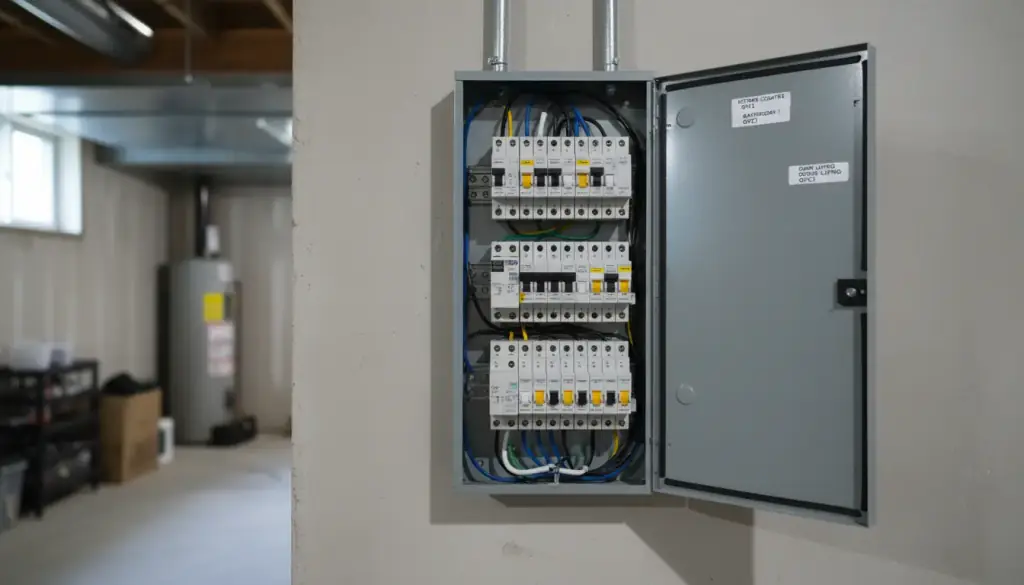
A residential electrical service panel with the door open, breakers neatly labeled inside.
100, 150, and 200 Amp: What Each Size Actually Carries
A 100 amp service is still a workable size for a smaller house running ordinary lighting, a few kitchen appliances, and a standard HVAC system, with little room left over for anything added later. It is the size most likely to run out of headroom the moment a homeowner wants an EV charger, a second HVAC zone, or a home addition.
150 amp sits in between, enough breathing room for most mid-size houses with central air, an electric range or dryer, and a modest set of additions, without carrying the extra cost of a service built for a much larger home.
200 amp is the size that comfortably carries a larger house, an EV charger, air conditioning, an electric range, and a finished basement or addition all at once, and it is where Vedder Electric points most homeowners who are upgrading rather than just patching what they have.
Chapter 03
How a Service Change Actually Runs
Upgrading a panel is not a single afternoon of swapping a box. The utility has to coordinate a shutdown so the meter can be pulled and reset once the new equipment is in, a permit has to be filed with the city, and the finished work has to pass inspection before it is closed up. Vedder Electric runs that whole sequence, so the homeowner is not the one calling the utility or tracking down an inspector. The office handles scheduling Monday through Friday, 8:00 AM to 4:30 PM, and can be reached at 734-662-6220 to start that process.
Every service job does not look the same once the panel itself is opened up. Beth Andersen's job was a relocation, not a straight swap: "Richard and Mike from Vedder came to my condo to update and relocate the electrical panel for the sump pump. They were outstanding, polite, efficient, punctual, and they used foot coverings every time they had to come into my home." Moving a panel to a better location, tying in equipment like a sump pump, and keeping a finished condo interior clean while doing it are all part of the same license Vedder Electric works under: Michigan Electrical Contractor License #6106506, active and in good standing.
Screw-In Fuses Are Not Interchangeable
Older Ann Arbor homes still running a fuse panel come with their own version of this problem. Screw-in Type S fuses are built so a 15 amp fuse and a 20 amp fuse cannot be swapped for each other by size alone, and that restriction exists for a reason: putting a 20 amp fuse into a socket built for a 15 amp circuit lets more current flow than the wiring behind it was ever meant to carry, which is a serious fire hazard, not a minor code technicality.
A homeowner who keeps blowing a fuse and reaches for a bigger one instead of finding out why the circuit is overloading is treating a warning sign as an inconvenience. The correct fix is putting the original size fuse back and having an electrician trace the actual overload, and it is often the same visit where a fuse panel gets replaced outright with a breaker panel sized to what the house actually runs today.
Vedder Electric. Licensed and insured. MI Electrical Contractor #6106506. Call 734-662-6220.